|
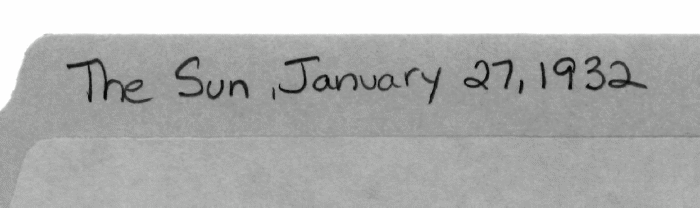
who had shot and killed his employer and who, after trying to kill himself, was taken from the Salisbury Hos pital, hanged and burned. Professo Mitchell's study, according to the re port issued today, attempted to discover the conditions in the community which made a lynching possible and the effects of the lynching upon the attitudes of the citizens. "Backward Conditions" "AS a contributory factor, Professor Mitchell cited the geographical isolation of the community, resulting in rather backward conditions. The chiel explanation given by the residents of the community for the lynching was that two serious crimes in which Negroes were accused had occurred in the locality shortly before, and had aroused public feeling.
"Professor Mitchell made a frank criticism of the attitude of the community as a whole, saying that two weeks after the lynching the place was rife with excuses for the hanging, if not, indeed, full of justification of it.
"Stimulated By -Criticism" "This attitude of self-defense stimulated by the criticism of Salisbury which came from other parts of the State. The sectional feeling was increased when a local newspaper stated that the Eastern Shore, on which Salisbury is located, feels 'that the greater part of the responsibility for it (the lynching) results from the interference of Baltimore city in the affairs of the Shore . . .' The sectional feeling ran so high that several Salisbury merchants even canceled orders with Baltimore firms.
"Professor Mitchell found only two citizens who had made any effort to prevent the lynching and comments that 'the most sorrowful reflection is not that some ignorant countrymen and townsmen gave way to violence, but that no one from among the intelligent and fair-minded citizens exerted himself with spirit and determination to stop the lynching.' Summary Of Conclusions "The conclusions of Professor Mitchell's study are summarized as follows: " 'In a sense, the Chesapeake Bay contributed to the lynching in Salisbury. That is, the Eastern Shore is isolated geographically, and has become backward in its mental and spiritual development. It is probably true, as one of the writers prominent in the controversy over the lynching has said, that the Eastern Shore has suffered from the removal of'many of its ablest young men. Allowing this to be true, it still must be said that the most sorrowful reflection is not that some ignorant countrymen and townsmen gave way to violence, but that no one from among the intelligent and fair-minded citizens exerted himself with spirit and determination to stop the lynching.
" 'Credit should be given to the two citizens (mentioned in the full report) who opposed the mob—one by protesting before the hanging occurred, the other by trying to prevent the barbarism of the burning. Officers Without Excuse, View " 'If it be said that it occurred too quickly, it is to be answered that there was probably knowledge in the town an hour or more beforehand that trouble was brewing. And if private citizens are to be excused the officers of the law have no excuse. It may fairly be concluded that the chief of police, his three patrolmen who were on duty and the Sheriff and his deputies offered no resistance to the lynching. .
" 'The impression was received by the inquirer that the public spirit of Salisbury is far below what is desirable. Those whom one would expect to be leaders in a crisis decided to fall in with the ignorant, the prejudiced, the frightened, the sullenly boastful.
" 'Salisbury has given proof of its lack of civic morality—not only in the lynching and burning but even more pointedly in the childish defenses offered for the lynching afterward. One
|