|
long enough delayed to let the lynchers escape.
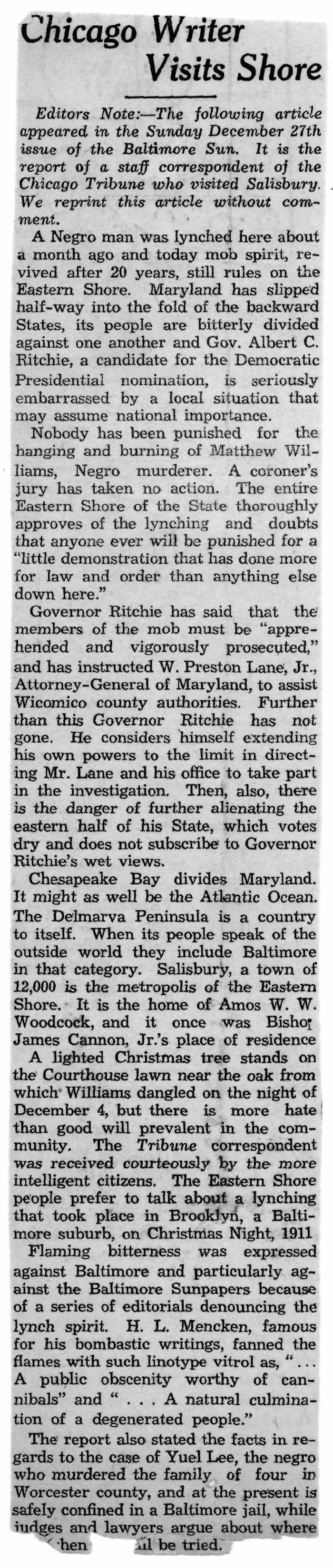
That is what happens from time to time all over the Bible Belt, and that is what happened at Salisbury. The makings of the lynching there were visible on the lower Shore ftr six weeks before Williams murdered Mr. Elliott; they were later described in detail by the Court of Appeals in its declaratory judgment in the Yuel Lee case. First, gangs of ruffians began to menace various prisoners, and the local police, too weak to protect them, had to flee with them to safety. Then the same or other ruffians threatened a lawyer in attendance upon court, and the local judg failed to punish them "or contempt. What followed was probably inevitable. TLj mob, sensing its power, awaited its chance. That chance came at Salisbury on December 4.
II HTHE time to stop all this, plainly enough, was at the start. If the first ohow of mob spirit had been met by vigorous resistance there would have been no lynching, and the Court of Appeals would have been spared the embarrassing need of describing a complete collapse of fair process in the Maryland Free State. But the local police on the lower Shore were either too feeble or too timorous to cope with the mob, and no on stepped forward to give them adequate reinforcement. All the natural leaders of the region—politicians, bankers, lawyers, clergymen, and so on—failed to function. Half a dozen of them might have organized a posse comitatus and put the ruffians to flight. But no one spoke up, and so the situation went on from bad to worse.
The tragedy of Salisbury does not lie in the fact that it houses a sufficiency of brutes to make a lynching. Just as many, no doubt, are to be found in any other Maryland county town, and in Baltimore there are countless more. The tragedy lies in the fact that, on its day of trial, Salisbury turned out to be quite without resolute and intelligent leaders. Not a single bigwig came forward in the emergency, though tl.e whole town knew what was afoot. Any one of a score of such bigwigs might have halted the crime, if only by threatening to denounce its prepetrators, but none spoke. So Williams was duly hanged, burned and mutilated, and Salisbury made the first pages of the whole country.
That any considerable number of educated Salisburiaus regard the lynching with satisfaction is too much to believe. In the feverish weeks, of charge and counter-charge that followed it some of them were misled into defending it, or at least into condoning it, but no doubt they now blush on remembering the fact. They must be well aware, on reflection, that the crime disgraced and defamed the town, and they must also be well aware that their own lack of public spirit, courage and initiative was a salient factor in making it possible. They cannot complain if the worst element in the whole lower Shore is now triumphant and defiant. They had their chance to strike for law and order, and they muffed it.
Ill l-JOW to prevent such things in future? The problem is not easy. In all the rural sections of the United States it is hard to organize a sound and effective public opinion. The cities tend to draw off most of the more intelligent young men, and the relatively few who stick it out at home are submerged in the general stupidity. It is to the interest of all the local professional politicians, revivalist clergymen, town boosters and other such racketeers to keep that stupidity at a maximum of densi y, and they devote themselves to the business wjth great energy. No one speaks out boldly for
IV
'T'HE specific campaign against lynching drags on ineptly. The various laws that have been suggested to put it down do not promise much. I myself once suggested fining the offending county some large sum—say $50,000 or $100,000—and making the fine a first lien upon all the local property. But that, I conclude on reflection, would simply penalize innocent people. The county Babbitts, who are mainly responsible for the bad government which makes Jynchings possible, would know how to escape their fair share, and the burden would fall upon the poor farmers.
In some of the Southern States an effort has been made to insure the conviction of lynchers by compulsory changes of venue, sometimes to adjoining counties and sometimes to distant ones. But there seems to be little in that plan either, for if the witnesses refuse to identify the lynchers at home there is not much chance that they will do so anywhere else. Nor is there much apparent utility in cashiering a sheriff who permits a lynching, for it is seldom possible to prove that - e actually consented to it, and if he is removed the local politicians are sure to make just as dubious a fellow his sue sor.
The one really promising remedy lies in organizing decent local opinion. That decent local opinion, in most of the rural parts of the United States, is now silent and hence without influence. It is seldom voiced in the county newspapers, and encornters only an implacable opposition from the clergy. The local politicians are naturally hostile to it, and in their ranks are at least two-thirds of the county lawyers. What it needs is new leaders— leaders who want nothing, and have nothing to sell. I believe that wherever and whenever such a leader hobs up in rural America, whether North o • South, East or West, he will meet with a very hearty response, and have a lot of fun. And if he is lucky he may also achieve some good.
|