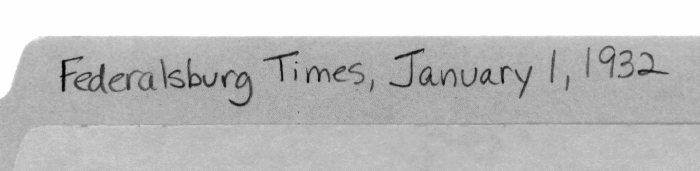
|
The I
[Copyright. 1932, by The K\
MO one, I take it, was surprised when the Wicomico county grand jury reported to Bailey, J., that it could not find the lynchers of Matthews Williams. That result, in such cases, is always expected, and it is -are for anticipation to be disappointed. It must he said for the Salisbury jurymen that, whatever their private hesitations may have been, they showed a rather unusual public diligence. They invited the Attorney-General of the State to sit with them, they accepted the aid of detectives from Baltimore, and they summoned more than a hundred witnesses. Moreover, they let it be known that anyone else who could throw any light upon the business would be heard freely. But no one seems to have come forward, and none of the persons actually examined knew anything. The lynching, it appears, was a sort of transcendental event, taking place in secular space but only dimly visible to mortal eyes. A large crowd turned out to enjoy it. but no one could make out who was running it.
What all this proves is plain enough. It is that lynchings, despite their apparent violation of all the laws of physics, are not really miracles in a vacuum, but incidents in a long and overt series of phenomena, stretching both backward and forward in time. The impulse to perform them, in all probability, is present everywhere and at all times. It shows itself in Baltimore every time a hold-up man is taken in the act or prohibition agents raid a respectable and popular saloon. But in order that it may lead t5 actual murder there must be a preliminary collapse of the police power, an antecedent breakdown of the orderly process of justice. Once that breakdown occurs a lynching is imminent, and once it has taken place the recovery is usually long enough delayed to let the lynchers escape.
That is what happens from time to time all over the Bible Belt, and that is what happened at Salisbury. The makings of the lynching there were visible on the lower Shore fir six weeks before Williams murdered Mr. Elliott; they were later described in detail by the Court of Appeals in its declaratory judgment in the Yuel Lee case. First, gangs of ruffians began to menace various prisoners, and the local police, too weak to protect them, had to flee with them to safety. Then the same or other ruffians threatened a lawyer in attendance upon court, and the local judg failed to punish them .-"or contempt. What followed was probably inevitable. TL3 mob, sensing its power, awaited its chance. That chance came at Salisbury on December 4.
II ""THE time to stop all this, plainly enough, was at the start. If the first .ihow of mob spirit had been met by vigorous resistance there would have been no lynching, and the Court of Appeals would have been spared the embarrassing need of describing a complete collapse of fair process in the Maryland Free State. But the local police on the lower Shore were either too feeble or too timorous to cope with the mob, and no on stepped forward to give them adequate reinforcement. All the natural leaders of the region—politicians, hankers, lawyers, clergymen, and so on—failed to function. Half a dozen of them might have organized a posse comitatus and put the ruffians to flight. But no one spoke up, and so the situation went on from bad to worse.
The tragedy of Salisbury does not lie in the fact that it houses a sufficiency of brutes to make a lynching. Just as many, no doubt, are to be found in any other Maryland county town, and in Baltimore there are countless more. The tragedy lies in the fact that, on its day of trial, Salisbury turned out to be quite without resolute and intelligent leaders. Not a single bigwig ca-ne forward in the emergency, though tie whole town knew
Psychosis
iViiiNCKEN
Republication without permission prohibited.]
* sense and decorum. The civilized mino: ity, contemplating the odds against i commonly withdraws into cynicism.
There was a time in the history of America when a landed aristocracy set the tone of rural opinion, and supplied impeccable if not always intelligent men for the principal local offices, but that time is no more. Politics in the country is now mainly in the hanf j of professionals out of the lower orders, and they are worse, if anything, than the politicians of the cities. They maintain friendly relations, on the one hand, with the local Babbitts—mortgage sharks, labor swea ers, dubious promoters, and so on, in-eluding the kept clergy—and on the other hand they have their lieutenants in the rustic underworld of bootleggers. The combination is hard to beat. It controls practically all the local agencies of public information. It knows how to hold and use its power. It is financed out of the public till.
Can it ever be overthrown? Perha; but surely not easily. It is, in the typica American county, so firmly intrenched that only a revolution could dispose of it. But not everywhere. In many a rural region, especially in the older States and certainly in Maryland, there is still a minority of unquestionably civilized men and women. It is small, and at the moment it is usually resigned to impotence and despair, but there are still powerful potentialities in it. Tt it were organized could make itself felt, and once it
ti-
ca!
.
it
began to show some strength it would attract many unexpected supporters. After all, no rational man wants to live in a place where shabby politicians go unchallenged, and there is no outlet for an enlightened public opinion, and public order is at the mercy of the worst element. The trouble is that, as things stand, too many .' mericans have no other choice.
IV
'"["'HE specific campaign against lynching drags on ineptly. The various laws that have been suggested to put it down do not promise much. I myself once suggested fining the offending county some large sum—say $50,000 or $100,000—and making the fine a first lien upon all the local property. But that, I conclude on reflection, would simply penalize innocent people. The county Babbitts, who are mainly responsible for the bad government which makes lynchings possible, would know how to escape their fair share, and the burden would fall upon the poor farmers.
In some of the Southern States a; effort has been made to insure the conviction of lynchers by compulsory changes of venue, sometimes to adjoining counties and sometimes to distant ones. But there seems to be little in that plan either, for if the witnesses refuse to identify the lynchers at home there is not much chance that they will do so anywhere else. Nor is there much apparent utility in cashiering a sheriff who permits a lynching, for it is seldom possible to prove that . e actually consented to it, and if he is removed the local politicians are sure to make just as dubious a fellow his sue sor.
The one really promising remedy lies in organizing decent local opinion. That decent local opinion, in most of the rural parts of the United States, is now silent and hence without influence. It is seldom voiced in the county newspapers, and encounters only an implacable opposition from the clergy. The local politicians are naturally hostile to it, and in their ranks are at least two-thirds of the county lawyers. What it needs is new leaders— leaders who want nothing, and have nothing to sell. I believe that wherever and whenever such a leader bobs up in rural America, whether North o-- South, East or West, he will meet with a very hearty response, and have a lot of fun. And if he is lucky he nay also achieve some good.
|