|
case wc reopened lay
chance additional evi-
* might be .overed. He in-
.^ated he believed that possibility
remote.
"And even then," he said, "the flisposition of such evidence would be up to the grand jury and not to the state. I know of nothing the etate can do in the matter." Governor Refuses Comment Governor Ritchie, talking by telephone from a suite in the Ambassador Hotel, New York, exhibited irritation when asked to comment on the grand jury's lynching report.
"I'm not going to say anything Until I have talked to Mr. Lane," the Governor said. "I wasn't in the grand jury room. I don't know what went on there or what evidence was placed before the jurors. How can I say anything now?"
Reminded that, although not present, he had full knowledge of the background of the case and was in position to give an opinion on the jury's failure to indict anyone, the Governor said-.
"But how can I say anything about something I know nothing about? I turned that investigation over to Mr. Lane and I'm certainly not going to say anything until I have talked with him.
"I don't understand why you call me, anyway. Here I am in New York. I didn't even know the results of the Salisbury grand jury Investigation until you told me." To Return Tonight The Governor said he would return to Baltimore by a late train tonight, but could not say when he would get an opportunity to discuss the Salisbury case with Mr. Lane.
The grand jury's report was returned at 5:50 p. m. yesterday, coming at the close of the fourth day of the investigation. In that time 128 witnesses were examined.
The jury's action was not unanticipated. As the investigation progressed it became increasingly evident that no indictments were to be returned.
Two Detectives Testify Some of the witnesses were c/'.es-tioned for only a few moments, while a few others, notably Sheriff G. Murray Phillips and Chief of Police N. H. Holland, of Salisbury, Were before the grand jury for as long as an hour.
First indications that there would be no indictments were seen when Mr. Lane and Assistant Attorney General G. C. Anderson, who assisted State's Attorney Levin C. Bailey in presenting the case to the grand Jury, returned from Salisbury to Baltimore before the jury had brought in its verdict.
When their departure in advance of the jury's report was reported around Salisbury, the general feeling was that no indictments would be returned.
Jury Criticized Here Although Levin C. Bailey, state's attorney of Wicomico County, expressed himself today as "very satisfied" with the work of the grand Jury in white-washing the Matthew Williams lynching case, criticism from various Baltimoreans was general.
"No comment is necessary regarding the jury's report," Mr. Bailey said in answer to a question as to his opinion of the failure of the group to return an indictment.
"I am very well satisfied with the Jury's work."
William Curran, Baltimore criminal lawyer, pointed out that the jury "certainly made fast work of their investigation."
'125 Days K:2ded' "I believe they examined 125 witnesses," Mr. Curran said, "and required only two full days and part of two other days to complete their Work.
"It strikes me that a complete investigation into the lynching would require nearly 125 days rather than less than a week."
J. Howard Payne, Negro attorney, laid;
"It is a misfortune for the State of Maryland that the jury failed to return an indictment. The opinion of a civilized and enlightened world could not be otherwise."
Shore Clergymen Undecided Clergymen at Salisbury were almost unanimous in their opinion that "the Williams case has so many angles that it is impossible to give an opinion without studying the case thoroughly."
Rev. J. A. Stewart, of Salisbury, said ministers of that city are divided in their stand on the case.
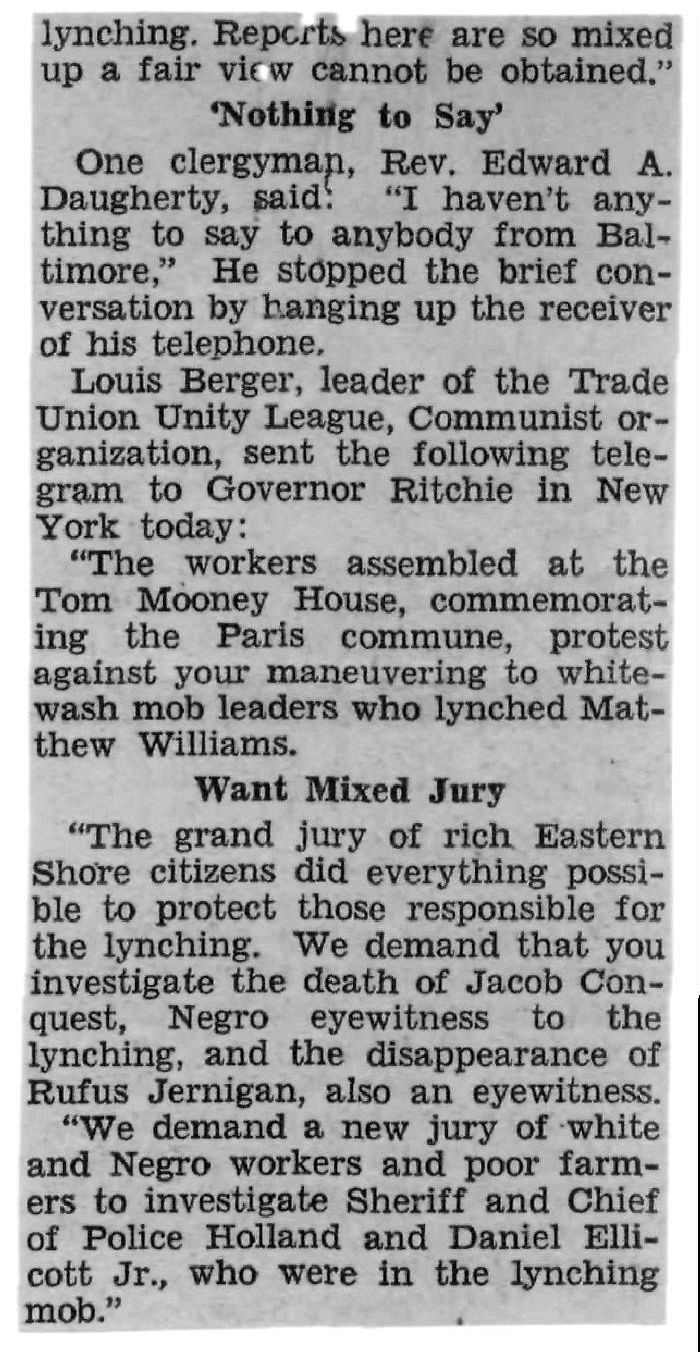
"Some believe indictments should have been returned and others take a more tolerant stand on the case," he said. "Personally, I have yet to get a clear version of the Williams
|