|
i WW
\ PRESS CUPPING SERVIG ,
l ALBANY BUFFflLf NEW YORK,
. MTtfCTOP [»fo, C#r*f»*) PTEWS Tnuraaay, Dacemoex i..'. li)al
*..„«,., ai» lwo ol ine most useuu woi^j u the. English language today.
''Oh, yeah?'!
Yeah!
(Central Press Staff Writer)
WASHINGTON, Dee. 17. — Congress, before which federal anti-lynching measures have been pending intermittently for a decade, began business this winter with three fresh lynching* near by Washington (one in neighboring Maryland, just before the session opened; the other two in not-far-distant West Virginia, just afterward) to remind the lawmakers that the matter still is unattended to.
It seems likely to be agitated considerably in the next few months, however.
Representatives of the National Equal nights association recently discussed It with President Hoover, who is said to be favorable to the repeatedly introduced Dyer bill, imposing ak, stiff financial penalty upon counties where lynch-ings occur, and legislative backing for the plan's adoption undoubtedly will be available in both congressional chambers.
* * * *
Democratic backing, of course, will he lacking, which, it is true, makes the bill's passage appear unlikely, with the present Jeffersonian majority in the house of representatives.
That there are strong arguments against it, on states' rights grounds, is indisputable.
Nevertheless, not a bad case can be made out for the contention that states which expect their rights to be respected should act more vigorously to prevent (or, at any rate, to punish) the outraging of national sentiment by such exhibitions of mob voilence as the latest ones at Salisbury, Md., and Lewisburg, W. Va., not to mention many others throughout Dixie in the last year.
* * * *
There is no suggestion, to be sure, that the negro who was hanged and burned at Salisbury and the two who were strung up and riddled with bullets at Lewisburg were not killers.
Apparently it is unquestioned that Matt Williams, the Marylander, had shot his white employer to death, accusing the employer of underpaying him for his work; that Tom Jackson and George Banks, the West Virginia pair, had slain a couple of constables in a fight at a colored folk's dance.
Yet perhaps it is noteworthy that no offense against white womanhood was charged in either instance.
In fact, records of the National Equal Rights association (for whatever they may be worth) indicate that this charge has been made in connection with fewer than one-fourth of all lynch-ings in the last 40 years.
* * * •
The number of lynchings again is on the increase, too.
Last year's score was 21, or nearly twice as mails' as for any previous twelvemonth save one (1926, with a total of 30) since 1923.
The assertion also is made that several of the victims were innocent.
Vigilantes in the old-time west were scrupulous to grant a trial to the prospective subject of a necktie party and really tried to be fair; there even were occasional acquittals.
Scarcely needful to state, the formality of a hearing is an unknown preliminary to lynchings of today.
Of 1930's victims, at least, two, according to the Equal Rights association's showing, based on an inquiry by a group of southern investigators, undoubtedly were guiltless of any offense at all, with 11 others "possibly" so.
* * • *
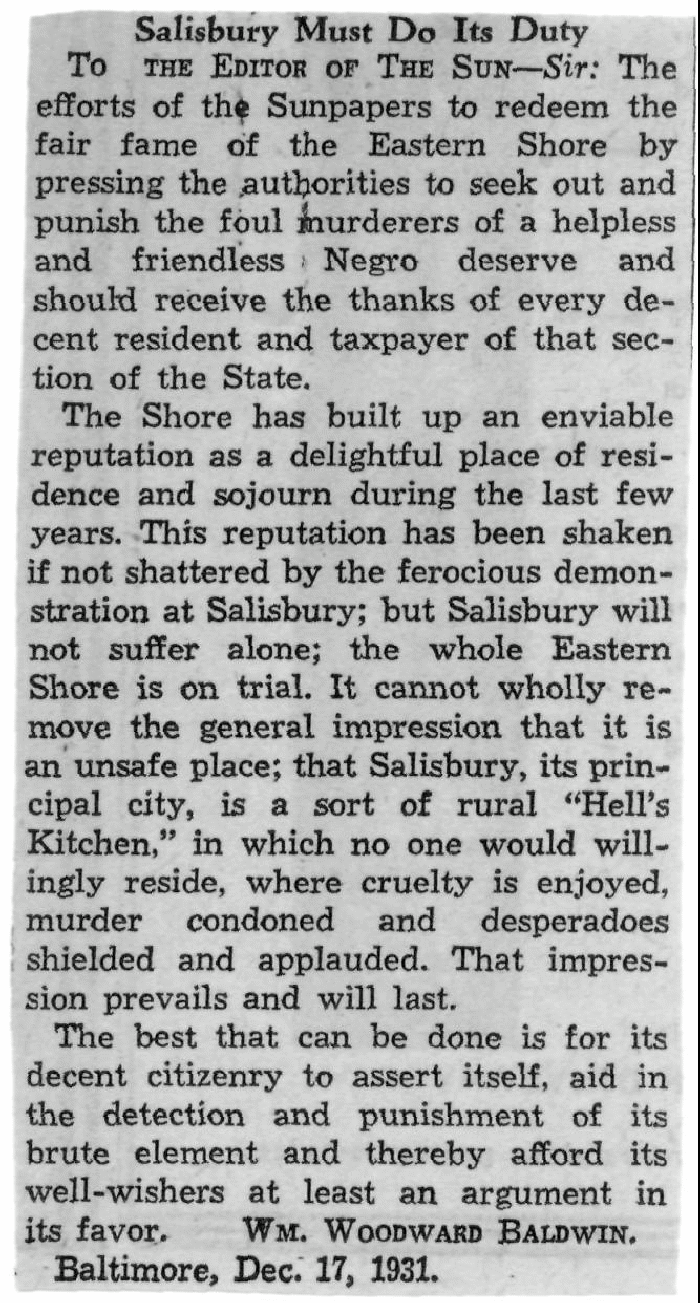
As a, reflection on the state authorities, the latest Maryland lynching appears to have been especially unpardonable, inasmuch as there were good reasons why they should have been on the alert.
Williams' shooting of his employer was the third crime in the same vicinity in which a black man had been involved within a fortnight, and race feeling was so acute that a lawyer sent by the Civil Liberties Union to defend one of the accused negroes, having been publicly assaulted without interference by the police, had appealed tor protection to Governor Ritchie, who replied that local officiaTfroW' ifSfmit^TS' maintain order and refused to act.
How far from correct was his estimate of conditions of orderliness in that part of Maryland was demonstrated by the Salisbury lynching a few days later. He embarrassingly had to curtail a visit he was paying to New York, to deliver a presidentially candidatorial speech, in order to make an investigation.
If the investigation leads to anything in particular, it will not be quite so bad.
jr^ r t v^ •"¦»-•
|