|
GOV. RITCHIE AND
THE PRESIDENCY
f3---
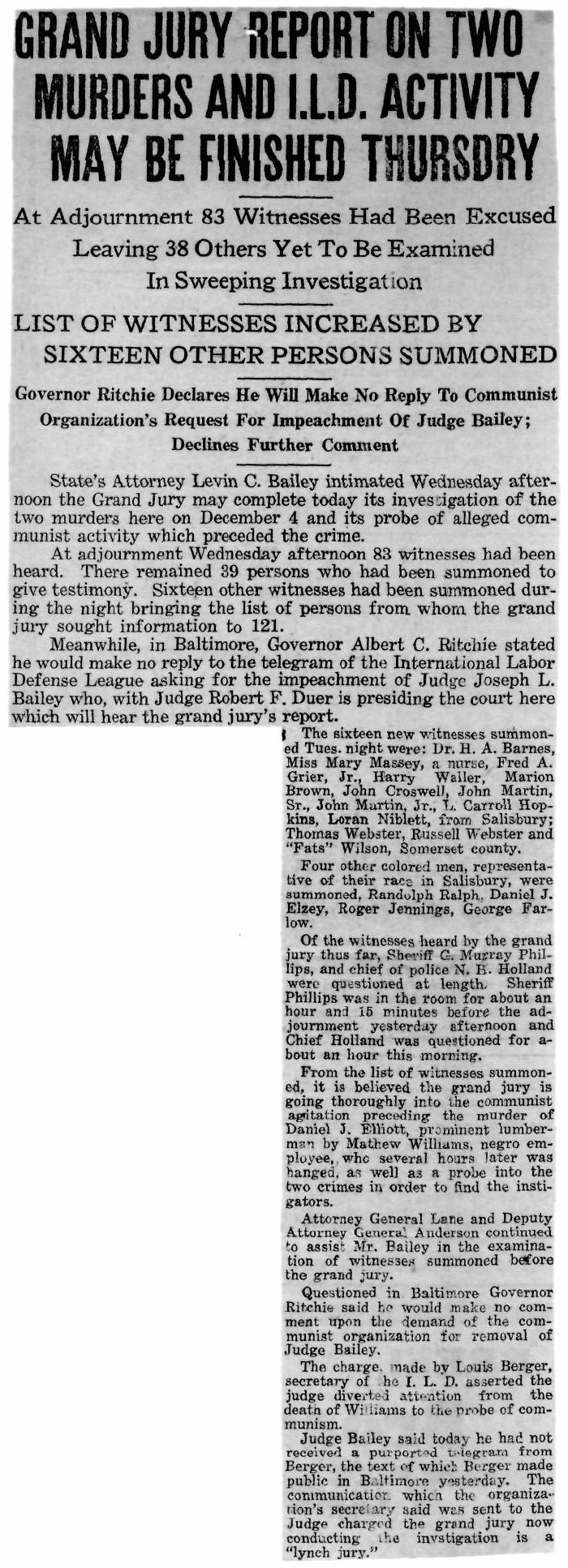
Criticism has) bean directed at Governor Albert C. Ritdhie for the lynching of the Negro tPilHaffiS here on December 4th and in some quarters it hits been insinuated, if not.openly expressed, that the occurrence will injure the governor's cha;: ees for the Democratic presidential no-nination.
Among- thour .tlul people such statements should ¦¦¦ accepted as another form of idle political gessip l'/.v.i has not the slightest foundation in tact. Traced to its source it will be found to originate from the governor's critics who seek to capitalize upon the lynching as a step in retarding the progress of popular acceptance of the Maryland executive as a presidential possibility. It is to the credit of the Maryland governor that his -.dversaries can find no other issues tu bee against him.
Governor Eitchie con id not have stopped the lynching, for the crime struck with such s iddenness that even local authorities—with an unquestioned record for efficiency—were found unprepared, and so quietly that only a very small proportion of the city's populace knew what had happened until the whole affair was over.
Under the Maryland Constitution adopted in IS7G, he went to the extremity of his gubernatorial authority when he instructed the Attorney-General to co-operate with the county State's Attorney in an investigation to establish the identity of the mob leaders.
As for bringing the offenders to trail—in the event they are identified —and as for, procuring convictions, that rests exckibkely v. till lite jurors in this ounty. No scute or federal authority c.'.n intervene.
No one thought of impeaching the president of the United States when a shot ivvm a Coast Guard vessel killed a member of the erew of the rum runner "I'm Alone". The president's responsibility in that case is even more firmly fixed than is Governor Ritchie's in connection with the lynching.
The position:, of the Governor of Maryland and the Governor of New York are somewhat analogous. The former's connection with the lynching case is as far removed as the latter's responsibility for the overt acts charged against certain courts and public officials in Now York city by the legislative investigating committee of that state.
Considering the facts as they actually exist, what, we might ask, does the lynching episode have to do with Governor Ritchie's ability to act upon such vital matters of national import as: a moratorium of inter-governmental debts, cancellation of war reparations, whether a high or moderately low tariff is for the best interests of American industry and the working man, government or private ownership of public utilities, farm relief, unempolyment relief, world disarmament, settlement of the controversy over rational prohibition, balancing of the ;" deral budget, conservation of na1' ¦' a] resources, and the thousand ar;< one other major problems before the American people today.
Compared with these vital matters the lynching, even though there had existed a fixed responsibility upon the governor, is certainly an inftntesthnal issue.
The lynching here was nothing more or less than a local revolt against Communistic influences that had made its appearance for several weeks previously. Ins ired by such teachings, the mob's victim, by his own confession, killed lis employer and planned to murder * foHT or five other people."
We have yet to hear in this city or in ether Eastern Shore counties mob violence condoned as a method of supplanting established courts of justice. We have heard many responsible citizens state they would give their individual fortunes if the clocks could be turned back to December 4, aid the lives of the murdered man and the mob's victim restored.
Yet our citizens are unwilling to see innocent persons—whether it be Governor Ritchie or any one of the hundreds or spectators—criticized or punished for an affai t«s which they
|