|
ing- to discuss future political action for the Negro. The sponsors of the convention throughout the convention kept and earlier pledge that the meeting would be a strictly non-partisan affair. No candidates were endorsed and no parties recommended; but while non-partisanship marked the general plan of the convention, it was plain to see that many delegates were there because they were "sore on the Republican party." And at least by inuendo many delegates so stated.
Civil Service reform, distribution of federal educational funds, lynching, economic opportunities, disfranchisement, women in public life, and religion and politics were the subjects discussed by over a score of speakers during the three crowded days of the convention.
Plans for permanent organization of the convention, with local chapters were made at the convention, despite efforts of other non-partisan organizations as the National Equal Rights League to block this reduplication of organizations. A committee to draw up a constitution was named with Congressman DePriest as its chairman.
One thing stood out in the convention above all others, namely, that the persons present were loud in their praise of Congressman DePriest. The Illinois representative took the plaudits of the icrowd as modestly as could be expected under the circumstances. jn only two occasions did the meeting get out of the hands of its sponsors. On one occasion, Mrs. Grace
ed by this interruption Mrs. Evans appealed to the house and said, "What is this anyway, a Methodist convention."
Pickens Leaves Platform
On another occasion in the final meeting, Dean William Pickens took occasion to harshly criticise the speech of President Mordecai Johnson of Howard University. Bishops Jones and Walls, defenders of the Howard President and the Negro church, jumped to their feet to object to what they thought was unwarranted criticism. Bishop Walls raised a point of order, and Dean Pickens who had been invited to speak by Judge Henry of Philadelphia, left the platform in disgust without waiting for the chairman to rule.
The following slate, elected in the early sessions of the conference, were made permanent officers: Congressman DePriest was elected chairman; James Kelly, Alabama, secretary; Mrs. B. A. Washington, corresponding secretary; Morris Lewis, treasurer; Louis T. Coates, registrar; Mrs. Dorothy Lewis and Mrs. Margarat Coates, clerks.
The following were chairmen of the committees of the conference: Executive, Bishop E. D. W. Jones; public address, Dean Kelly Miller; Civil Service, Robert L. Vann; women in public life, Mrs. Sallie W. Stewart; lynching, the Rev. J. C. Austin; religion and politics, the Rev. J. Edgar Thompson; disfranchisement, Mrs. Ella G. Berry; credentials, L. F. Coates, and distribution of educational funds, Garnet C. Wilkinson.
URGE HOOVER'
SUPPORT TO BAN
LYNCHING EVIL
Washington, D. C—(CNS)—The National Equal Rights League which held a two-day session here last week ealled on President Hoover on Monday and urged him to give his active support to anti-lynching legislation by the next congress.
According to William M. Trotter of Boston, who headed the delegation, the president was sympathetic to their pleas, but suggested that the proposals be taken to congress. The president, he added, was not prepared to commit himself on the proposed anti-lynching law.
"The result of this segregation and general discrimination," said Trotter, "is the development of a permanent caste system in the United States. The effect is to make us known as the American untouchables."
National officers for 1931-32 are: President, Maurice W. Spencer, Washington, D. C; first vice president, Bishop W. J. Walls, Chicago, 111.; second vice president, Rev. B. W. Swain, Louisville, Ky.; third vice president, George E. Gordon, Mass.; recording secretary, Elisha A. Almond, Washington, D. C; assistant recording secretary, Thomas A. Johnson, Washington, D. C; Chaplain, Rev. C. C. Som-erville, Portsmouth, Virginia, and petition commission, T. H. R. Clarke, Washington, D. C.
KANSAS CITY IS READY FOR THE KAPPA THRONG
J. M. (JIM) NABRIT, Jr.
At a meeting of the executive committee of the Harris County Negro Democratic Club, held on Monday of this week, Julius White, president of the club, announced that he had appointed J. M. (Jim) Nabrit, Jr., as chairman of the executive committee, to succeed C. F. Richardson, Sr., resigned. Mr. Nabrit has entered upon the discharge of his duties, having presided at Monday's meeting and having offered some very valuable suggestions as to the future program of the club.
When interviewed by a representative of The Informer, Mr. Nabrit gave out the following statement:
"The necessity for paying our poll tax is more than ever apparent at this time, when we view the many problems of taxation ' and unemployment which confront a divided congress; and when we realize that next year all city, county, state and federal officers will be voted upon. We need a poll tax receipt to vote. We need to vote as citizens and taxpayers.
"It is rny sincere Wief thai, with the successful filing of t;he brief of
The Houston Informer, Julius White,
president of the Harris County Ne-|to Bethel Baptist Church, where she
at a local hospital, where she had been taken the previous evening for an emergency operation.
Mrs. Colvin, a native of Galveston, was a graduate of Central High School, and held the degree of A. B. from Fisk University, class of 1908. She was brilliant in literary achievements, author of many short stories, and skilled in dramatics, having produced in Houston, Damon and Pythias, Scenes from Idylls of the King, MacBeth, Hamlet, and other Shakespearean plays.
At Fisk she was a member of the D. L. V. Club, of which she at one time or another held all of the important offices, including that of president. There she was also a member of the Fisk Herald (the student paper) staff, and in this position received her first training in journalism. At the time of her unexpected and premature death she was the society editor of the Houston Defender.
After graduation from Fisk Mrs. Colvin taught at Texas College, Tyler, for two years, after which she began teaching English in Houston. For 20 years she was a teacher in the Houston schools. Six or eight years of that time was spent at Langston, part at old Colored High, and six years at Jack Yat.;s High.
In December, 1921, she was married happily to P. C. Colvin, well known citizen of Gib' * Hous-
ton. Prior to thi' was a member
Church, but in ort j ... ne
husband she move : her membership
MRS. E. C. BAUL, who o one of Houston's most exclusiv ty shoppes, states that since o her business in this city on D Street, she has built up a lar most exclusive trade among m acting patrons. Her first ven business was begun in the Wi Building about one year ago place became too small for her ing patronage.
Mrs. Baul is a finished proi some of the best beauty schools country and has demonstrated Houston public her ability as ness woman. She has found it sary to seek larger quarters this end she has removed her to the Ferrill Building just acr street from her former place shoppe is now located at 2320 ling Street, and her phone nun the same—Capital 6782. Mrs is extending an invitation to 1 trons to visit her in her new q where she will be glad to serv in a more effective manner th fore because of her larger quar
T f»*>
GOP HEAD ASK PARTY TO BACK POLL TAX RALLY
To All Negro Republican Voters of
Harris County:
I take this method of calling your attention to the "Citizens Poll Tax Campaign" which is being waged in this county. It is' my opinion that this is a cause which demands the careful attention of every Negro in Harris County, and should have his unstinted support regardless of party affiliation.
In view of the foregoing facts and by the authority in me vested as chairman of the Harris County Negro Republican Club, I hereby call upon every Republican elector in the county to join hands with the Citizens Poll Tax Campaign in its endeavor to make the campaign a success, and to lend whatever other aid possible toward getting for the Negroes of Harris County the unquestioned right of suffrage.
Respectfully, James M. Burr, chairman Harris County Negro Republican Club; attest, Chas. Crouch, Sec'y.
By ROY GARVIN
Kansas City, Mo.—Elaborate plans are now under way to make the 21st annual grand chapter of Kappa Alpha Psi the largest and best in the history of the organization. Definite assurance has been given by both the grand chapter and the Kansas City alumni chapter that the annual meeting would be held in the "Heart of America," from Dec. 27 to 31 inclusive. Notwithstanding the present economic conditions the Kappas are expecting a large attendance. Chapter Attendance Stressed
For the first time, entire chapters are expected to journey to the Kansas City meeting. The conclave is expected to be a revival of Kappa spirit. With this in mind, the host chapter is arranging a series of unique features with which to inspire the attending delegates. The largest delegations will come from the states of Indiana, Illinois, Kansas, Minnesota, Iowa, Ohio, Michigan, Oklahoma and Texas, although large representations are expected from the Atlantic Seaboard. In a statement to the Kansas City chapter, A. Moore Shearin, grand polemarch, promised one hundred percent support of the three thousand members of the fraternity. Elaborate Plans for Entertainment
Many social organizations have planned affairs for the visiting delegates. Among these are the popular Frogs club, Beau Brummel's, A. K. A.'s, Alpha Phi Alpha, Delta Sigma Theta, and others.
The Kansas City Chamber of Commerce, according to Dr. J. Edgar Dibble, may provide adequate decorations for the streets in the vicinity of convention headquarters. Since Kansas City prides herself as a convention city, it is more^than probable that the decorations will be given. The fraternity, like other Greek letter organizations, is made up of a cross section of America's outstanding Ne groes in the professional and commercial fields in addition to large numbers of undergraduates, including such names as A. A. Alexander, Des Monies; Dr. Crump, Minneapolis; Bishop W. T. Vernon, Little Rock; C. C. Spaulding, Durham, N. C; A. Moore Shearin, Durham, N. C, grand polemarch; Earl B. Dickerson, W. Ellis Stewart, J. Emert Wilkins, Chicago; F. B. Ransom, Indianapolis; Elder W. Diggs, the founder of Kappa Alpha Psi, Indianapolis; H. A. Tynes, New York; E. Washington Rhodes, Philadelphia.
Gilbert Jones, president Wilber-force University; George F. David of Wilberforce and G. Victor Cools, New York City; Duke Slater, famous Iowa star; J. Thompson Lorrick, Chicago, and many others.
gro Democratic Club, and C. N. Love, by the Supreme Court of the United States over the objection of white Democrats of Texas, a new day is dawning for Negroes in American political life.
"To exercise the elective franchise is our right. To organize' is our duty. Let us begin by paying our poll
tax and by attending the very inter- *l, and several other churches during esting and informative meetings be- " ing held each Monday night by the Citizens Poll Tax Campaign. Every citizen in Houston is not only welcome, but is urged to attend these meetings."
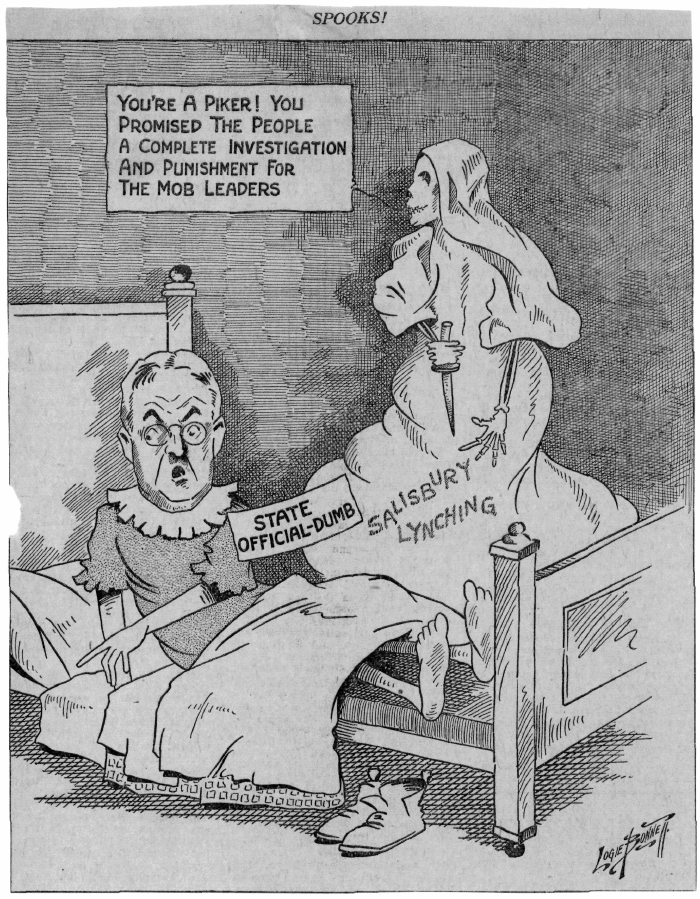
ANTI-LYNCHING BILL SUBMITTED IN TENNESSEE
Nashville, Tenn.—(CNS)—An anti-lynching Ml was introduced into the state legislature here last Tuesday by Representative George Chamlee, Jr., of Ha m i 11 o n. Representative Chamlee is the son of George Chamlee, Sr., the Chatanooga lawyer retained by the International Labor Defense to defend the eight condemned Negro youths in the Scottsboro case.
The measure provides for the payment of $1000 to $5000 to the "lynchee" or his dependents in event of injury or death. For a beating or serious injury, the victim can recover $1,000, for permanent disability, $5,-000 and a like amount to his dependents or nearest relative in case he dies. .While the county would be obligated for damages, it may recover from any member of the mob or may issue a special levy to pay for the lynching sprees.
A mob is described in the bill as "a collection of people assembled for an unlawful purpose and intending to do damage or injury to any one or pretending to exercise correctional power by violence."
Any act of violence is construed as a "lynching" in the language of the bill. "Any person present with hostile intent" is a member of a mob.
gave helpful service to the time of her death. In connection with the Bethel .Missionary Society, Mrs. Colvin was well known for having produced dramatic readings of Bible stories. The story of Ruth and Naomi was one of her favorites. Hous-tonians will recall that this was given at Antioch, Bethel, Payne's -Chap-
the past two years.
Mrs. Colvin also attained a reputation as a public speaker. A few years ago she was called to Fisk University, her alma mater, to deliver the annual address to the alumni association. On repeated occasions she performed a similar service for her high school alma mater, Central High at Galveston. It will be remembered that she introduced Congressman DePriest upon the occasion of his visit to Houston last July.
Mrs. Colvin was very much in the hearts of all of the children whom she taught, and especially the girls. More than one young woman in Houston can point to Mrs. Colvin as having helped her over a steep place. She especially delighted in decorating churches and homes for the weddings of the girls whom she loved, and she never failed to be present at the funeral of the humblest child whom she had ever taught.
At Jack Yates P;gh School she was
OSTAl
ANNOUNCE PI OF EXPANS!
sponsor of the arlowe Dramatic Club, whose mer -s are plunged in deep grief at he,r «. . dden demise.
Mrs. Colvin was a member of the Household of Ruth and also of the Eastern Star. She took an active part in these organizations.
For more than six weeks Mrs. colvin had been complaining about a pain in her side. She prided herself in her reputation of perfect attendance at Jack Yates, and when urged by students and co-workers to go home, she expressed the desire to stay on until the holidays, at which time she said she would go to a physician. She completed her day on Wednesday of last week, the eve of Thanksgiving, her last official duty being the oversight of the student Thanksgiving program. Children and teach- tlon was almost a certainty. T
Washington, D. C— (CNS officers of the National Posta a'nce, an association of 5,000 postal employees and members Negro press were present la day at a banquet given in thei by the local branch of the asso which has its national headq in this city. At this meeting ficers announced their intenti increasing membership to incl least 10,000 new postal emp Roy D. Wilhoite of St. Louis, tional president of the organ pointed out that it was the on of its kind for colored postal w It served the purpose of bringi gether in the common cause a ployees of this branch of the 1 government.
V. David Bond, president Chicago branch of the organ spoke of the need of getting the workers in the post office sential facts relative to Negro ers. He said that in a numbe stances, the association had be to accomplish real benefits fo and he felt that the acquisitioi
LINCOLN UNIVERSITY DEAN
LECTURES AT PRINCETON
Princeton, N. J.—(CNS)—The Rev. Dr. George Johnson, dean of the Theological Seminary and professor of systematic theology at Lincoln University delivered the annual series of lectures of the L. P. Stone Foundation at Princeton Seminary here from Monday through Friday. Dr. Johnson's subject was, "Evangelical Calvinism and Modern Problems." He has taught at Lincoln University in Pennsylvania since 1902.
NEW BUILDING IS DEDICATED
Okolona, Miss.—( CNS )—McDou-gall Hall, newly erected building of the Okolona Industrial School, was formally dedicated last Friday. The building is to be used as a girls' science hall. Hon. T. A. Stovall, president of the board of trustees and Bishop Theodore Bratton were the principal speakers at the ceremonies.
Negro supervisor in Chicag largely due to the activity of sociation.
Other speakers at the were Judge Edward W. Henry ladelphia; Colonel West A. Hs Robert J. Nelson, Trezevant A of the Associated Negro Pre John Davis of the Capital New ice.
Judge Henry Boomed
At the meeting Judge Hen introduced as the next congr representative from the new district of Pennsylvania. Tl resentatives of the associatio Philadelphia, pledged their sup the campaign of the Quaker C ist, and indicated that his
ers were shocked that she did not reappear on the following Monday morning.
Late Friday afternoon she was removed to a local hospital, where she underwent an operation on Saturday morning. As the word flashed over the wire about 10:30 a. m., that Viola Webber-Colvin had just died on the operating table, her friends were dumb with grief.
Mrs. Colvin leaves to mourn her loss a husband, P. C. Colvin of Houston; two sisters, a nephew and niece of Galveston, and a host of sorrowing friends, co-workers, and devoted pupils.
Funeral services were held from Bethel Baptist Church, Tuesday afternoon of this week at 2 o'clock, with Rev. A. J. Newton, pastor of Trinity M. E. Church, officiating. Interment was in Oak Park Cemetery.
UNCLE TOM'S CABIN SHOWN
AT AUSTRALIAN CHURCHES
Sydney, Australia.—(CNs) —Uncle Tom's Cabin, the photoplay based on the famous novel of Harriet Beecher Stowe, has been shown here and elsewhere in various churches in Australia and New Zealand.
the second time during the wet large organizations had endors candidacy of Judge Henry. in the week J. Finley Wilson ai er Elks leaders • had issued statements endorsing him. Tl that there are 1,500 colored employees in Judge Henry's < made the endorsement of the I al Postal Alliance a valuable o:
DAROW COMPLETES STC
Chicago, 111.—(CNS)—Clare Darrow, veteran of many cou ties, and the great champion man rights, has completed hi; biography, which is to be pu in February as "The Story Life."
"There will be no bragging book," he stated. recently. " tell the experiences of almost ty-five years of living, which be of interest. There will b< than a half century of experie fore the bar.
"There will be something-good bit of it—on my ideas things I hold to be an integral a man's life. Religion and my ticism, prohibition, crime and 1 will be there."
|