|
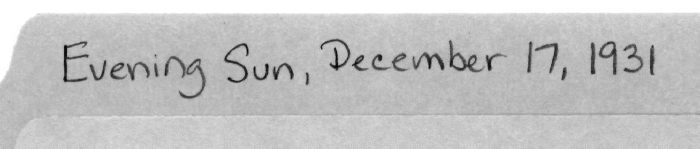
This Gentle Lady Seems To Be Suffering From The Eastern Shore Complex To the Editor of The Evening Sun—Sir:
After reading Mr. H. L. Mencken's columns, I have just one desire—to see him walk down a street in Salisbury and tell the people his name. I'm afraid there would be a second lynching in the State of Maryland in 1931, but one over which we could all heave a sigh of relief.
The description of the "warmed-up Poco-moke brother" describes my feelings exactly. If I were a clever cartoonist, I should draw him as an ugly beast with a swell head (empty on certain subjects) and long crawly feet. Maybe my description would be better if I would just say something so low that it would have to chin itself to spit in the gutter.
Mr. Mencken's initials, H. L., are the first and last letters of hell, which is, no doubt, another good description of him.
But, on second thought, a man does have to earn his living, but why give all the hell to the Eastern Shore of Maryland.
Baltimore, Dec. 14. Beatrice Lovell.
Both
To the Editor of The Evening Sun—Sir: A man is hanged on courthouse grounds (without a permit from a judge). Is this contempt of court or only murder? Baltimore, Dec. 14. W. H. Logue, Jr.
What The Negro Thinks—And Feels To the Editor of The Evening Sun—Sir:
If thinking is the correlation of ideas and the drawing of logical conclusions, the Negro does not always think. But, thoughtful or thoughtless, he feels.
Where the laws, customs and prejudices of white men are concerned, if the Negro fancies they may be ignored or defied with impunity his mental processes are defective.
The white man makes the law mindful of hfc own interests. The black has nothing to say about Maryland law in the making. If he is benefited by it, that is only incidental; but he must obey it. The white man interprets and executes the law never to his own detriment. He may try to be impartial, but he is human and when its rigor binds he frequently flexes it to his own advantage as against others.
Maryland Negroes know these things. They know, too, that all the wealth and power derived from wealth are in the hands of white men; that white outnumbers black as five to one. In such circumstances any Negro who thinks will try to be "good." Most of them are good. They think it unfair that thousands of loyal, industrious, law-abiding folk should be forgotten because a madman runs amuck and en entire race should be made to suffer scorn and ignominy for the crime of one.
The author of Eastern Shore Kultur showed poor taste in the selection of • subject for remarks which he evidently meant to be humorous—at least in part. In so far as race relations are concerned, this section is not noticeably different from other parts of the State (including Baltimore) or from the neighboring States of Delaware. Pennsylvania and New Jersey. The writer has lived in each during the last half century long enough to become familiar with local conditions. The adults of both races lead distinctly separate lives. Churches, fraternity rooms and places of amusement are used by each to the practical exclusion of the other. In hotels and restaurants even where the law forbids discrimination a way is usually found to discourage the attempt of Negroes to seek accommodations. White people who are disposed to be kindly regard the Negro with an amused contempt, haughty condescension, or toleration without cordiality. Among the more hostile it is contempt without humor and a sedulous purpose to make the Negro know his place and keep it. I repeat that every Negro who thinks knows he cannot ignore or defy the conditions of his environment. Unfortunately, some do not think, but all feel. One who feels himself the object of suspicion, scorn and hate cannot be happy in his contacts with those who so regard him. But the Shore Negro patiently endures and faithfully serves notwithstanding. He has become inured to the situation. If he does not enjoy it neither does he keenly resent it, and, with doglike fidelity, loves and trusts. Other things equal, the average Negro will serve a white man rather than one of his own race, and believe a white man's plain word rather than a Negro's solemn oath.
Events likp the Ivnrhini* n* Will;am«
|