|
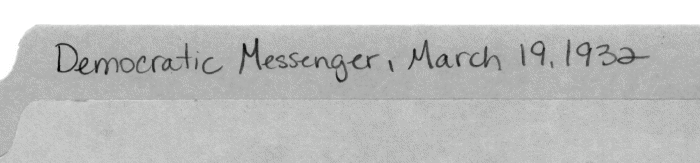
Prof, Broadus Mitchel Shown In Unfavorabl Light By Association'.
(An Editorial in Salisbury Times)
"The report of Prof. Broadus Mitchell to the Federal Council of the Churches of Christ in America holding up to derision the morality, intellect and religious practices of this entire community was so ridiculously replete with fallacies we did not consider it worthy of an answer when it was first published. Since then so much prominence has been given his report that we feel impelled to offer some facts in rebuttal. For, after all, it is extremely difficult for any blue-blooded American to sit idly by and witness the spectacle of a wholesale indictment of the ideals and the institutions established by his progenitors and which have provided the necessary nurture and comfort to his people for many generations.
The professor of political economy at Johns Hopkins University concludes after interviewing a dozen persons during a three-day visit here, that Salisbury is lacking in "civic morality," its residents are mentally deficient and they fail to "apply religion to life," and he tries to find an explanation for this in what he terms our "isolation."
We started out to find the spectroscope through which Prof. Mitchell observed us and his viewpoint on the general scheme of things, that we might the better understand how he arrived at his conclusions.
In pursuance of this we learned from a source we considered authentic that Prof. Mitchell's name1 appeared a year ago on a membership roster of the American Civil Liberties Union, of which Dr. Arthur O. Lovejoy, professor of philosophy at Johns Hopkins, is the Baltimore chairman.
Prof. Mitchell was asked in a telegram if he is still a member of the A. C. L. U. Receiving no reply after four days we communicated with him by telephone. In the conversation that followed he would neither deny nor affirm that he is at present a member, but speaking of that communist organization, he asserted: "I heartily agree with what they stand for and what they are doing."
Concerning the organization he so heartily endorses, a committee of Congress, investigating communistic propaganda in the United States, recently made this report:
"The American Civil Liberties Union is closely affiliated with the communist movement in the United States, and fully 90 per cent of its efforts are on behalf of communists who have come into conflict with the law. It claims to stand for free speech, free press and free assembly; but it is quite apparent that the main function of the A. C. L. U. is to attempt to protect the communists in their advocacy of force and violence to overthrow the government, replacing the American flag by a red flag and erecting a Soviet government in place of the Republican form of government guaranteed to each State by the Federal Constitution."
A committee of the New York Legislature, back in 1928, reached the following conclusion: i
"The American Civil Liberties Union, in the last analysis, is a supporter of all subversive movements; its propaganda is detrimental to the interests of the State. It attempts not only to protect crime but to encourage attacks upon our institutions in every form."
Roger N. Baldwin, the guiding spirit of the A. C. L. U., is to Prof. Mitchell the personification of a hero, for he said: "I know Mr. Baldwin personally, and I think more of him for the work he is doing."
This is the same Roger N. Baldwin who was formerly a member of the I. W. W. and served a term in prison as a draft dodger during the war.
Testifying before the Congressional committee, Baldwin was asked:
"Does your organization uphold the right of a citizen or alien—it does not make any difference which—to advocate murder?"
"Yes," the witness replied.
"Or assassination?"
"Yes."
would have been virtually impossible for Prof. Mitchell to come to Salisbury unprejudiced of mind or without preconceived conclusions.
Is it any wonder, then, that he submitted a report that was bound to create a rift in the greatest of all our American institutions—the Christian church ?
It is not easy to understand why any member of the Federal Council of Churches would employ a man noted for his socialistic teachings to investigate and report upon a community where more than 99 per cent of the white inhabitants are active church members or have a stated religious preference except that the Council did not know the type of man they were assigning to this mission.
As an illustration of the point we wish to make: A Federal prohibition administrator would not hire a notorious bootlegger to investigate and re port upon the operations of the en forcement officers under supervision o: the administrator.
No time was wasted in getting the report before the public for it appeared in some of the Baltimore newspapers two weeks before it was released through regular channels by the Churoh Council.
The report may be worthy of a citation for the distinguished service its authored has rendered to the cause of the Soviet government, but what about the humiliation it has brought a Christian, English speaking people here in Salisbury ?
If the Council is desirous of investigating the existing situation here, Sal-isburians would welcome a properly accredited individual or commission, but we do not relish the injury Prof. Mitchell has inflicted upon us."
;
T
DECLARES FOR SHORE
-------------
Dr. Ames Says Dr. Mitchell's
Report Does Not Represent
Hopkins Viewpoint
Salisbury, Md., Feb. 9.—In a letter published in the Salisbury Times, Dr. Joseph S. Ames, president of the Johns Hopkins University, declared it would be "unjust" to regard the report of Dr. Broadus Mitchell, associate professor of political economy at the institution, on the lynching of Matthew Williams, negro, here December 4, as representing the point of view of the university.
Dr. Mitchell's report, made to the Federal Council of the Churches of Christ in America, described the Eastern Shore as "backward in its mental and spiritual development."
Praises Shore Civilization
"I have spent, myself, a great deal of time on the Eastern Shore, and I have never met anyone there whom I have not liked," Dr. Ames wrote.
"I have never come in contact with any questions dealing with religion or politics when I have been there, but my whole reaction toward the civilization on the Eastern Shore is that I think it is fine, and I have often said that I would like to live there.
"I never have any desire to interfere with any one else's opinions, nor do I have any desire to change anyone's opinion. The regret I have in regard to Dr. Mitchell and all the publicity in connection with it is that some people may associate this uni-versitv with bis noint nf view.
|