|
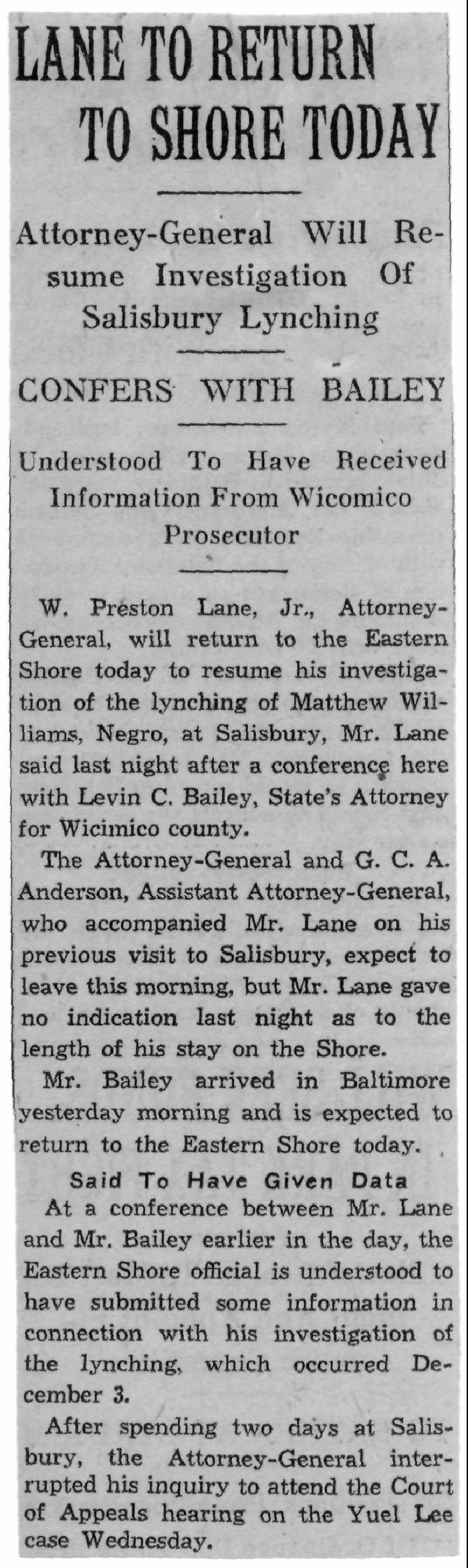
THE SALISBURY LYNCHING
There must be *io Slackening in Attorney-General Lane's investigation into the Salisbury lynching. We sj>y this without intention to suggest indifference upon Mr. Lane's part. On the contrary, he is a fearless and resolute official. But the policy of reserve which was proper while the State's investiga-! tion was being started may easily slide into forgetfulness. And there are always with us the soft-voiced teachers of the doctrine— least said, soonest mended. The investigation of the Salisbury lynching must not be smothered with that doctrine.
A mob in Salisbury took the law into its own hands, the first time that has happened in this State in twenty years. It surrendered itself to bestialities which probably are without parallel in the history of Maryland. It hung the Negro murderer in a manner designed not to bring death to him, but satisfaction to its own cruel lusts—repeatedly lifting and dropping the man at the end of a rope. And that was not enough. The lynchers took the body down when there was no certainty of death and dragged it through the streets. They poured gasoline over the body when there was no absolute certainty that life had departed, although that is probable. They set fire to the body. And then, in the blackness of night, they disposed of the charred flesh and bones in what manner none save the members of the mob can say. The public knows only that in the morning the body was found in a woods outside the limits of the town.
Least said, soonest mended, is not endurable doctrine in the face of such horror even if responsibility lay solely upon a small murderous mob that got out of hand. In this case a negative responsibility lies upon the whole community of Salisbury. Although the danger of mob violence was evident, the officials of Wicomico county and of Salisbury made no effort to guard against emergency. The State's Attorney left for an engagement twenty I miles away. The chief of police set up only a nominal guard at the hospital where the Negro had been taken. The Sheriff had to be told what was happening. And there is no evidence that at any time between the murder of Mr. Elliott in mid-afternoon and the lynching at night did a single representative citizen of Salisbury raise an emphatic voice for law and order. When mob violence occurs under such circumstances it is imperative that the issue be fought to a finish, not only to punish actual criminals, but to clear the mind of the community.
It is said that the murder of Mr. Elliott was atrocious. Of course it was. It is said that the people of Salisbury, his neighbors, were enraged. Of course they were. But the difference between proceeding in the dignity of the law to punish atrocity and proceeding in the orgiastic fury of mobs is the difference that sets apart civilized people from primitives. Do the good people of Salisbury suppose that in the long upward march of civilization only unatrocious murders, if any such thing can be imagined, have been reserved to the law for punishment? And if they are in doubt on that point, are they willing to establish a precedent that the low, the ignorant and the violent shall be the absolute judges of when a murder is sufficiently mild and tolerable to be turned over to the law? And when they think of the murdered man, their neighbor, Mr. Elliott, do they suppose that they placed a fitting memorial to his useful and kindly life among them when they permitted his death to be made the occasion for such an orgy?
Nor can the delays in the Yuel Lee case provide an excuse for the Salisbury lynching. Nothing can provide an excuse for such degradation of a whole community. In the Yuel Lee case the courts are now trying to extricate themselves. In the Salisbury case nothing will do save firm assertion of the State's authority against the mob. Let-up would be another disgrace. It is the duty of Governor Ritchie and Attorney-General Lane to regard no difficulties as insuperable. The names of the leaders of the lynching mob, the names of members, are known to many persons in Salisbury and in Wicomico county. Those men can be apprehended. They must be ap-
|